TD Direct Investing · Product Designer (acting lead)
Fractional Trading
Letting people invest a flat dollar amount in any stock, even one that costs hundreds, on a TD platform built entirely around whole shares.
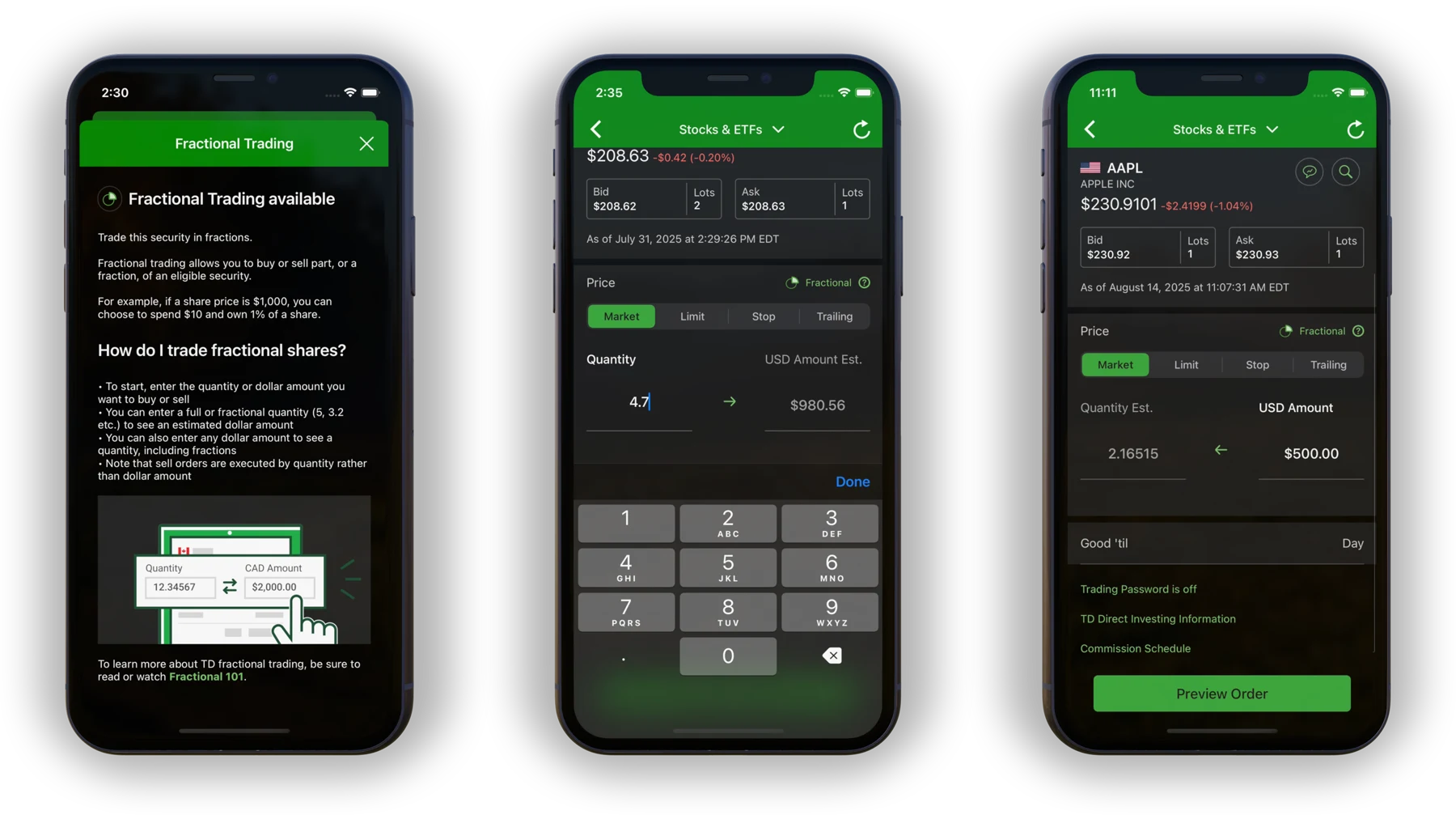
I owned the end-to-end interaction model for TD’s first fractional trading product, the feature that lets someone invest a flat dollar amount in any stock instead of forcing them to buy a whole share that might cost hundreds.
The hard part was the ground it ran on: a platform built entirely around whole shares, and an API that only allowed market orders. So I designed for dollars, not shares, and built the ticket around the amount people actually have to invest. When the business wanted one version and I believed in another, I tested the disagreement instead of arguing it, and the simpler, all-at-a-glance model won on the numbers. Along the way I noticed screen readers couldn’t describe a fractional trade in a way a blind user could act on, so I built an accessibility pattern for it that other teams went on to adopt.
Outcomes
What shipped, and what it moved.
- 1st to market among Canada's Big Five banks
- $177M projected revenue over five years
- SUS 84.79 usability score; 11 of 12 participants reasoned in dollars
- 1 pattern screen-reader pattern for the trade ticket, adopted by other TD teams
Perspectives
Why this project is worth your time, depending on what you came to evaluate.
Product leadership
I made the strategic case for designing in dollars when the platform, and the business, were built around whole shares.
When leadership preferred a step-based ticket, I tested the disagreement rather than argued it, and let twelve users decide. The simpler, all-at-a-glance model won on the numbers and shipped first among Canada's Big Five banks.
Design
I built the ticket around the amount someone has to invest, not the shares they can afford.
Instead of a step-based flow, I designed a flexible inline model where the dollar figure and the estimated quantity translate live as you type. In testing, eleven of twelve participants reasoned in dollars, confirming the mental model the whole design was built on.
Engineering
The interaction model absorbed a legacy platform built for whole shares and an API that allowed market orders only.
Working with engineering, dollars translate to estimated shares as you type, the flow adapts when the market is closed, and validation covered 70+ edge cases. The screen-reader pattern we defined together shipped as a standard other TD teams adopted.